Sacraments
The seven sacraments
"Christ instituted the sacraments of the new law. There are seven: Baptism, Confirmation (or Chrismation), the Eucharist, Penance, the Anointing of the Sick, Holy Orders and Matrimony. The seven sacraments touch all the stages and all the important moments of Christian life: they give birth and increase, healing and mission to the Christian's life of faith. There is thus a certain resemblance between the stages of natural life and the stages of the spiritual life." (Catechism of the Catholic Church, 1210)
Through the Sacraments we deepen our bond with Christ and with one another. Everything we do, we do for the greater glory of God.
Baptism
The Beginning of Life in Faith
In the sacrament of Holy Baptism, reborn of water and the Holy Spirit, we become a new creation, grafted into Christ; we become children of God and form a community—the People of God, the Church.
Baptism is a sacrament of faith, for as Jesus teaches: “Whoever believes and is baptized will be saved” (Mk 16:16). Therefore, children are baptized in the faith of the Church—a faith publicly professed by the parents, godparents, and other participants in the rite. By requesting Baptism for their child, parents commit themselves to providing a Christian upbringing—to which children have a right—so that, in time, they may personally affirm the faith into which they were baptized. (From the liturgy for the Baptism of children).
Responsibilities of Parents and Godparents
During the liturgy of Holy Baptism, parents and godparents are expected not only to be present but also to profess the faith in which the child is being baptized. If one of the child’s parents is unable to make this profession of faith (for example, because they are not Catholic), they may remain silent; however, they must consent to the child being raised in the faith received through Holy Baptism.
Parents should, in advance, choose a name (or names) for their child that reflect their belonging to the Church—specifically, the names of saints or blesseds who will serve as role models and intercessors before God. Following the celebration of Holy Baptism, the parents—grateful to God and committed to the responsibilities they have undertaken—have a duty to nurture the new life begun at Baptism through a Christian upbringing within the family. This includes integrating prayer into daily life, facilitating the child’s acquisition of religious knowledge, and preparing them for the Sacraments of Reconciliation (Confession), the Eucharist, and Confirmation.
Religious life within the family—prayer, the sacramental life of parents and siblings, the Christian observance of Sunday, and mutual respect—will serve as the best school of faith for a child.
Godparents
Regarding the selection of godparents, the following Church regulations apply and should be taken into account before choosing a godfather and godmother:
- Godparents must be Catholics who have received the sacrament of Confirmation, who regularly receive the sacraments, and—if they are married—who are in a sacramental marriage.
- They should be connected to a specific faith community or parish. Godparents from outside the parish should provide a letter from their own parish priest confirming that they are practicing parishioners.
The Church establishes these requirements for godparents because, during the baptismal rite, they profess the faith in their own name and accept a shared responsibility for raising the child in the faith of the Catholic Church.
Pre-Baptismal Catechesis
Before a child’s baptism, parents and godparents participate in a catechetical session—a preparation for the sacrament. The meeting focuses on reviewing the tenets of the faith, discussing the responsibilities of parents and godparents, and explaining the liturgy of the Sacrament of Baptism. This pre-baptismal catechesis is conducted in either Polish or English. Information regarding the date can be obtained from the parish office.
Liturgy of Baptism
The Sacrament of Baptism may take place during Sunday Mass or at another time convenient for the family. The Sacrament of Baptism is a celebration of the Church community. We encourage parents to invite relatives, friends, and fellow parishioners to take part in the liturgy.
Registration for a Child’s Baptism
Baptism must be requested in person by the parents at the parish office. Parents should be registered parishioners who actively participate in the life of the parish community.
Reconciliation
Introduction
The Sacrament of Reconciliation (Penance, Confession) brings to us God’s merciful forgiveness for sins which we committed after baptism. Through the priest, who takes His place, Jesus comes to forgive our sins and to give us His peace when we are sorry for them and are willing to make up for them by our prayers and sacrifices.
It is called the Sacrament of Reconciliation because it helps us to make peace not only with God, but also with people whom we may have hurt. When we go to confession, we admit that we are sinners and we ask pardon of God and the Church, because the Church is also wounded by our sins.
The power to forgive sins is a part of the power of the priesthood.
Precepts Of The Church
One of the Precepts instructs us to receive Holy Communion frequently and the Sacrament of Reconciliation regularly.
Forms of Reconciliation
There are three forms of the Sacrament of Reconciliation:
- Reconciliation of Individual Penitents
- Reconciliation of Several Penitents with Individual Confession
- General Confession and General Absolution
(only in special cases with the Bishop’s
permission)
In St. Agatha’s parish community, we celebrate the first form – Reconciliation of Individual Penitents.
Preparation for Reconciliation
Preparation for the Sacrament of Reconciliation occurs in the second grade. The parents and the priest, along with his staff, prepares the children for their First Confession before First Communion.
For adults who are interested in receiving the Sacraments of Initiation (First Confession and First Communion), there is a special one-year program: Rite of Christian Initiation of Adults (RCIA). This program prepares these adults for their Christian life and the reception of their First Confession and First Holy Communion. The program usually concludes during the Easter Vigil Liturgy on Holy Saturday.
How to Make a Good Confession
Here are some important considerations for making a good confession:
First, the examination of conscience a few minutes spent in reflecting on any sins and faults since the last confession. This may consist of calling to mind Jesus’ Commandment of Love, the Ten Commandments of God, the Precepts of the Church and how we are living our Christian life.
Second, Contrition or sorrow should be enkindled in one’s heart. No sin is ever forgiven without sorrow.
Third, decide not to sin again. There is no real sorrow unless this element is present.
Fourth, the actual confession of all sins. All mortal sins must be confessed.
Fifth, do your “penance.” Not only the symbolic penance given by the priest but voluntarily add some of your own prayers and good acts of charity.
Rite of Reconciliation
Follow these guidelines when in the confessional:
- Greet the priest.
- Make the Sign of the Cross.
- Read from or listen to the Word of God
(optional).
- Confess all your sins.
- Speak about anything that is troubling you.
- Listen to the priest’s advice.
- Accept your penance.
- Pray an act of contrition.
- Receive absolution, silently making the Sign
of the Cross. Respond, “Amen.”
Suggested proclamation of praise and dismissal: * Priest: Give thanks to the Lord for he is good.
- Response: His mercy endures forever.
After leaving the confessional, spend some time in quiet prayer, reflection, and thanksgiving.
Please note
The Sacrament of Reconciliation (Penance, Confession) shall not be celebrated during the Liturgy of the Mass in the Church.
The Sacrament of Reconciliation is offered at Saint Agatha’s Monday to Thursday from 7:30 to 7:55 AM (before Mass), on Friday from 6:10 to 6:45 PM (before Mass), on Saturday from 4:00 to 4:20 PM (before Mass), and on Sunday from 7:30 to 7:50 AM and 9:30 to 9:50 AM (before the Masses).
During Advent or Lent, you will find additional hours of confession. Please check your parish bulletin for the specific times and information. Our parishioners may also contact the priest to set up a time for individual confession.
First Communion
Related to the Polish School. Please call the parish office.
Confirmation
Related to the Polish School. Please call the parish office.
Marriage
If you wish to be married at Saint Agatha’s Church, first ask yourself these important questions:
Am I a Parishioner?
A parishioner is a registered member of our parish community.
Am I a practicing Catholic?
A practicing Catholic is one who joins that Parish family for Sunday worship on a weekly basis has a mature understanding of the Catholic faith and participates in the life of the Catholic Church.
Every Catholic should complete his or her initiation into the Faith by receiving the Sacrament of Confirmation. If you have not been confirmed, the time of your preparation for marriage can be an opportunity to prepare for Confirmation also.
Initial Contact
At least six months before the desired date of marriage, the bride and groom must contact the parish office for an initial appointment. Couples are asked to attend a marriage preparation program, which is mandatory in the Archdiocese of St. Louis. Premarriage courses are organized in some parishes. You can choose either an Engaged Encounter or one of the approved Archdiocesan programs. The Premarriage Program consists of several sessions. Such topics as communication, conflict problem solving, sexuality, Christian family life and planned parenthood are discussed. If you have any questions concerning your marriage in the Catholic Church, please call the parish office.
Prenuptial Information Form
An engaged couple makes an appointment with the priest to fill out a Prenuptial Information Form. Catholics provide a recent copy of their Baptismal and Confirmation Certificates. Baptized Christians are also required to present a Certificate of Baptism. A person who is Catholic or a person who is wishing to marry a Catholic must provide proof of no earlier marriage bonds that apply to him or her. No wedding date can be set when there is an unresolved prior bond. A valid Missouri Marriage License should be obtained at least one month prior to the date of marriage.
Situations and Circumstances
If the couple is dealing with religious differences, premarital pregnancy or possible addiction, they deserve more individual attention. In some cases the Church requires a dispensation or permission from the diocesan bishop through the Tribunal. Cohabitating couples cannot be refused marriage, but their consciousness should be raised.
Planning the Liturgy
The couple plans the ceremony together with the priest who will witness the marriage. A marriage can be celebrated with a Mass or without. Catholic weddings are to take place in churches, chapels, or regular places of worship designated by the local bishop.
Sacrament of Reconciliation
Catholics are encouraged to receive the Sacrament of Reconciliation before their wedding to experience not only God’s mercy, but also God’s gift of healing so that they might enter marriage as selflessly and spiritually whole as possible.
Music
Couples should contact our organist, choir or musicians if desired. The phone numbers are available at the parish office. The wedding ceremony in the church is a sacred celebration; all music used at the wedding must be expressive of Christian faith and liturgically appropriate. Selections drawn from scriptural and liturgical texts are most suitable.
Flowers and Decorations
An arrangement for flowers is the responsibility of the couple. Delivery should be made in ample time before the ceremony. Insurance prevents the use of aisle runners, rice, or confetti.
Rehearsal
A date and time for your rehearsal should be discussed with the priest arranging your marriage. The rehearsal normally will not last more than 45 minutes. All members of the wedding party should be present for the rehearsal: bride, groom, best man, maid of honor, ushers, bridesmaids, parents of the bride and groom, lectors, etc.
Official Witnesses
Two official witnesses are required. Usually, the best man and maid of honor are the official witnesses who may also sign the documents.
Photography and Video Taping
It must be remembered that the wedding liturgy is a sacred, communal prayer. Thus, persons taking pictures should always be inconspicuous and discreet. They must avoid becoming a distraction to the assembly. Flash and flood lights are to be avoided.
Financial Offerings
The offering on the occasion of marriage, given at the discretion of the couple, is an expression of thanks to God for the gifts of their lives and their new vocations together. It is an offering to the parish church and is not a gift to the priest.
New Family in the Parish
Please remember to register with a new parish if you plan on relocating. You can be a member of a territorial parish (the nearest Catholic Church) or a personal (ethnic) parish.
Anointing of the Sick
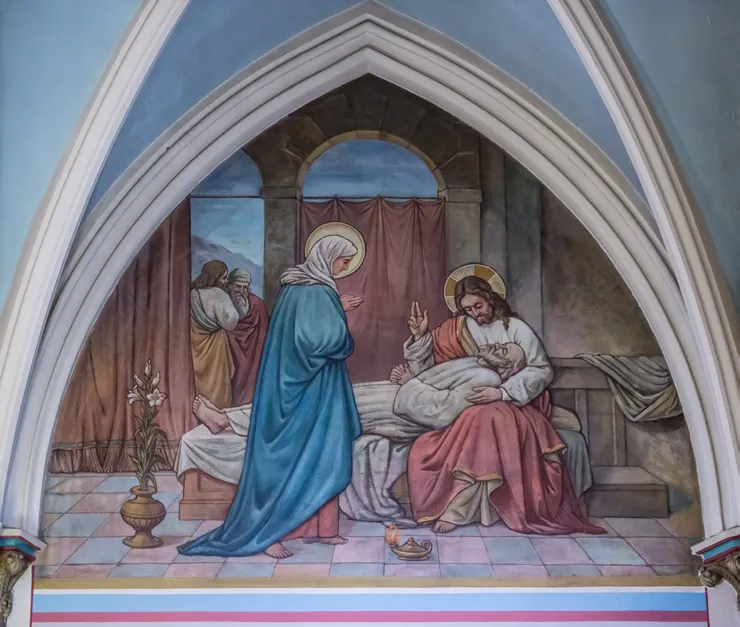
Every first Friday of the month, after making arrangements.
In case of impending death, please call the parish office at any time.
Funeral
How do Christians approach death
Nearly every person encounters death many times during a lifetime. Deaths of family members, friends, and neighbors are intensely personal encounters. Reports of other deaths may not be personally involving, but they are also encounters with death for us. Every death is a preparation for our own death.
“Life is changed, not taken away.” As Christians, we believe that death is a transition, not an end. We believe that Jesus’ dying destroyed our death and that rising, he restored our life.
We live in a complex society and the legalities surrounding death may seem cumbersome. To leave a will and to furnish information about insurance and death benefits is a great kindness to your survivors. A will is a legal document, usually drawn up by a lawyer and witnessed by at least two people.
The Church wishes to accompany the dying Christian with prayer. The greatest expression of this is viaticum: Holy Communion received by the Christian when in danger of death.
Christian funeral
Many duties must be carried out and many decisions must be made at the time of death. In the face of death, the Church proclaims that God has created each person for eternal life and that Jesus, the Son of God, by his death and resurrection, has opened the gates of heaven to us. Christians celebrate the funeral rites to offer worship, praise and thanksgiving to God for the gift of life which has now been returned to God.
The Church, through its funeral rites, commends the dead to God’s merciful love and pleads for the forgiveness of their sins.
The celebration of the Christian funeral brings hope and consolation to the living. The funeral rite reminds all who participate about God’s mercy and judgment and meets the human need to always turn to God in times of crisis.
Arrangements for Christian burial
At the funeral home
The family chooses the funeral director based upon professional standards, long service in the community, church participation or friendship. The funeral director can help in coordinating with the parish church for the time of the wake, funeral liturgy and committal at the cemetery, and also can publish the obituary notice.
At church
Arrangements for Christian burial should be made in person by members of the family with a priest at Saint Agatha’s Parish. Liturgical planning is part of the preparation. Friends and relatives are encouraged to participate in areas such as choosing the readings, music and prayers.
The Christian Burial Rite should reflect the hope and joy of Christian faith in eternal life. We encourage congregational singing at the funeral Mass.
The rites of Christian burial
The funeral liturgy for members of St. Agatha’s Parish usually consists of three parts:
1. The Vigil or Wake Service is usually celebrated the evening before the Mass of Christian Burial. The Church desires that special emphasis be given to the Word of God contained in the Scriptures. In the words of the general introduction to the revised rites of Christian Burial we read, “proclaim the paschal mystery, support the hope of reunion in the kingdom of God, teach respect for the dead and encourage the witness of Christian living.”
There is the opportunity for the family to pray the Rosary during the Vigil Service. The Vigil Service usually takes place at the Funeral Home.
2. The Mass of Christian Burial. The principal rite of Christian Burial is the Eucharistic sacrifice of Jesus Christ which brings to the present Jesus’ saving death and resurrection. A brief homily based on the readings is given during the mass, but never any kind of a eulogy. It is appropriate for the family or member of an organization to deliver a eulogy at the funeral home or at the cemetery.
Catholics fully participate in the celebration of the Eucharist when they receive the Holy Communion. Only those Catholics who are free of grave sin and seek to live in charity and love with their neighbors are properly disposed to receive Communion. Person conscious of grave sin must first be reconciled with God and the Church through the sacrament of reconciliation. Requests for individual confession at a convenient time to the grieving members of the family can be arranged.
During the Funeral Mass, these religious symbols may be used:
- Cross – expresses Christian faith
- Holy Water – is a reminder of the saving waters of Baptism
- Funeral Pall – is a reminder of the white garment given at Baptism
- Easter Candle – is a reminder to the faithful of Christ’s constant presence among us and of his victory over death
- Incense – is a sign of honor to the deceased body and of the community’s prayers rising to the throne of God
- Bible – a sign that Christians live by the Word of God and that fidelity to that Word leads to eternal life
- Flowers – are a symbol of love for the deceased person and should be taken to the cemetery after the Mass in the church.
3. Committal Service.
Prayers of Commendation and Farewell occur at the cemetery. Catholics choose to be buried in a Catholic cemetery as a final and public expression of Faith.
It is our tradition of burying the dead in a grave as Jesus himself was buried. Cremation is permitted by the Church, provided that it is not a denial of faith in the resurrection of the dead and should be buried.
Immediately after the burial many families share a meal together. The Parish Hall can be used for this gathering, but there are some restrictions.
We encourage parishioners who are able, to participate in a funeral. “Bury the dead” – assisting at a funeral is a corporal work of mercy. It is also a spiritual work of mercy “to comfort the sorrowful… to pray for the living and the dead.”
Financial offerings
It is customary for families to make a financial offering to the Church at the time of a funeral. The offering to the Church is at the discretion of the family. The offering is a donation to the Parish Church and is not a gift to the priest.
Memorial donations
The death of a member of a family or friend often prompts a desire to do something special as a sign of respect and true sorrow as someone leaves this life. There are many ways of expressing this respect. Among these are the offerings for the Saint Agatha’s Maintenance Fund, for Memorial Masses or for your favorite charities.